Clearance cards were an adjunct to train orders. L.E. Trump explains:
"The 'clearance' (it wasnt really a "card" as such) was a little pre-printed slip of paper about four by five inches or so provided in pads to the train-order operators along with the train order blanks. The Clearance form had places for the operator to fill in the Train number, numbers of the train orders it was to be issued with, and a clearance notation with the initials of the Dispatcher. Clearance forms were always copied in duplicate, or more copies, depending on how many copies of the orders there were. One clearance form had to go with each order delivery, and one copy went to the station file with the station copies of the orders."
John Norwood explains the procedure for "clearing" a train:
"The operator laid out the required number of copies on the table in reverse order sequence of the orders he intended to deliver; he then prepared the clearance card (set up with CC size carbons) to have a CC to go with each set of orders. Preparation included: date, train designation, and order numbers in reverse sequence. When this was done (He usually signed his own full last name while preparing the card) he called the dispatcher, followed by his office call and the abbreviation "CLR" for Clear. Dispatcher would reply "GA" (Go Ahead). The operator then sent, "Clear Extra 489 West with x number of orders, 25, 21, 19 (etc)". The DS checked the numbers while writing them on a line in the Clearance Card page of the Train Order Book. (The first thing we dispatchers did after checking and signing the "Transfer" page, was to start a clean CC Page and separation lines drawn vertically and headed: Stn (station); Train; Numbers; OK (time OKed). His response to operators request to clear a train was "Clear Extra 489 West OK 1010 AM". The operator wrote the time and if not already done signed his own full last name. He then folded the orders with CC on the outside and delivered them.
The operator was then free to deliver the orders to the train crew either by "handing them up" or delivering in person. If a "31" order was involved the operator obtained conductor and engineman's signatures before asking the dispatcher to clear.
A copy of the clearance was delivered with each set of the orders, and a copy was filed with the train order office copies of the orders, for future reference if anything happened later.
The whole purpose of the clearance was a double-check between the dispatcher and the operator that they both had the correct order numbers, and the correct number of orders for the correct train."
Not all movements required issued train orders. Trains running per the published schedule, plus sections of track operating under "yard limit rules" were not required to have orders or clearances. L.E. Trump remembers the final years of the Silverton and Farmington branches:
"The passenger train ran as scheduled No.s 461-462 and did not have to have orders, since it was scheduled on the timetable. Any extra or work-extra trains run were done on "go and return"* orders given to them at Durango. This is the way it was when I worked there. The agency at Silverton had been closed a long time by then. The depots at Aztec and Farmington used city phones for their business, and the trains were run on "go and return" train orders given to them at Durango. In later years, the Farmington branch was all in yard limits, and no orders were used at all."
* "Go and return" could be issued to a train if it was to be the ONLY one on the branch or section of track. If a second train was in prospect the order would read: Eng 481 run extra Durango to Farmington. After Extra 463 West arrives at Farmington Eng 481 run extra Farmington to Durango. This order was annulled at 11:59 PM. The latter so trains planned the next day could be operated without an operator being available at Farmington to furnish an "OS" for either train. If, for any reason, either train could not reach Farmington or Durango by 11:59 PM they must be in the clear at some station, or apply Rule 99 (flagging).
TRAIN ORDER BOARDS
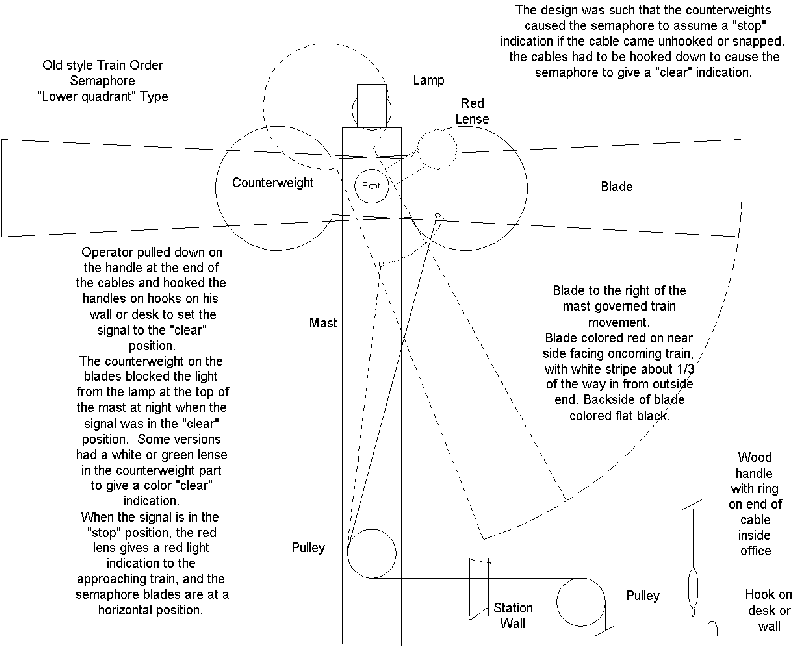
A "train order board" was a means of visual signalling moving trains. They indicated to a moving train that an order was to be delivered. The DRGW used both the "Swift" and the more familiar blade type semaphores. Both had lanterns with colored lenses for nighttime usage. Essentially three messages could be signalled by the order board: stop (receive "31" order), slow and receive "19" type order, and proceed.