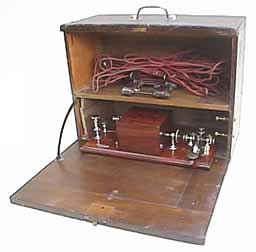
In 1999 a very interesting telegraph set was acquired by a well known collector of these instruments. The evidence provided by the prior owner of this set indicates that it was associated with the "Nomad" business car in the 1950s. The "Nomad" was the name given this car after it had sold to a private party and had been restored by its new owner.
Some information on the "Nomad" business car
Included with the set is a pole diagram. Handwritten on the back is "Diagram for Box #34 B. Car". It is dated April 16, 1900. Business car B was built by Jackson and Sharp in 1882. This car was destroyed in a derailment and fire in 1917 ("Rio Grande Narrow Gauge Varnish" by Herb Danneman, page 284). If this set was indeed on that car in the accident, it can only be assumed it survived and was transferred to another car. Equally likely the boxes got mixed around and never stayed on any particular car. Based on the handwritten note, there were at least 34 of these sets. Perhaps others have survived.
Click here to view images of the set with explanations of its components. Click on the thumbnails for a detailed view.
With help from D&RGW veterans John Norwood and L.E. Trump this set's origins and use on the railroad are now clear.
My suspicions are confirmed! That box is obviously one of several that were carried on certain D&RG RR business and wrecker outfit cars in the early days of the D&RG RR before the advent of train dispatching telephones. These boxes were described in the writings of John B. Norwood in his series about the Denver & Rio Grande Western Rairoad. Myself and Greg Raven have been and are carrying on considerable correspondence with John about this subject, and it is most interesting to actually be able to view one of the genuine articles described. The reference to "B" may indicate this box was once assigned to Business Car "B". Mr. Norwood listed in his wiritings the various outfit cars and business cars that were assigned these boxes, although they were little used in the post 1920 period due to the installation of dispatchers telephones on most of the road, except the Narrow Gauge lines.
This box is typical of the "wrecking boxes" carried along for the purpose of establishing a temporary telegraphic connection with the railroad dispatcher, and/or Company Headquarters from a derailment, washout, rockslide or some similar happening along the railroad.
In practice, these "wrecking boxes" were used whenever a situation arose that required cutting in on a telegraph wire at some location where there was no open telegraph office. An extra-board telegraph operator would be assigned to the job and would have to eat and sleep in whatever accomodations were available while on the job, usually the work train mess car and bunk cars, while keeping an ear on the Morse instrument at all times. This could be a pretty miserable existence if the weather was bad at a derailment or other work site in such an unsheltered environment. Of course, if it was on a Business Car, the accommodations might be a little more amenable, at least as far as eating and sleeping were concerned.
There was a strong anti-crosscraft labor situation that prohibited railroad employees other than telegraphers from doing the temporary telegraph jobs. Other employees doing so would usually cause the railroad management to not only pay whoever actually did the work, but also pay a duplicate wage to the next available telegrapher on the extra board.
The "wrecking box" was a quick solution to the need for immediate, temporary communications at some location. More permanent "offices" would usually be set up in an outfit car spotted on a spur somewhere near where the communications were needed, if the job was to require more than a few days to complete.
The pictures you provided pretty well explain how the box was attached to a nearby telegraph pole. The box was simply hung by the chain around the pole and supported by the cleats on the back which rested against the pole and held the box in place. Usually the assigned operator or perhaps a lineman would climb the pole with climbing irons, or "spurs" attached to his legs and feet, and attach the wrecking clamp to the desired wire near the crossarm or bracket on the pole. Picking the right wire was assisted by the blueprint of the polehead diagrams contained in the box. Then the small wire downleads were attached to the wrecking clamp binding posts, and finally the telegraph wire was cut in the middle of the clamp to "cut in" or place the portable instrument in circuit.
When the portable telegraph office was no longer required, the circuit closer on the wrecking clamp was closed to "cut the wire through", and the downleads detached. The wrecking clamp had to be left in place until a lineman could come along and attach his tensioning strap (kind of a leather block and tackle with a special grip attached to each end which gripped the wire without damaging it, while the ends were pulled back together) to the wire on either side of the clamp, pull up the "slack" and properly wind a Western Union splice to rejoin the cut ends of the wire. Usually, a short section of wire would have to be put in and two splices would have to be made, unless enough slack could be pulled to overlap the cut ends of the wire six inches or more to make the splice.
Special clamps were employed to grip the overlapped ends of the wire, and twist the splice, then lineman's pliers were used to wrap the "buttons" at each end of the twisted splice. The completed splice then had to be soldered with a heated soldering copper to properly complete the work and to avoid the joint developing high resistance over time and exposure to the elements. It sounds like a lot of work to do all this, and it was. A linemans job was and is hard work.
The wrecking box was then stowed away to await its next duty, wherever and whenever it might be needed.
L.E. Trump
John B. Norwood, retired D&RGW Trainmaster and former telegrapher had this to say about the "wrecking sets":
"As to the wrecking box, in the days when many officials, trainmen, enginemen and others could telegraph and phones were not common these were on every wrecker outfit, and official's business car."
From "Rio Grande Narrow Gauge Recollections", Chapter 5 "Slide Clearance on the Silverton Branch 1952", Norwood notes the use of one of sets: "1952 was a Leap Year--on February 29 we finally hold through Twin Shed Slide and hoped it would not run again. Up until this time I had been making reports using a box-relay and Morse key cut into the telegraph line, but a slide finally wiped it out, so I skiied into Silverton to report."
"So many of these "pony sets" had been junked, lost, or stolen with the coming of the telephones I had trouble finding one to take along on the train we used to clear the slides that winter 1951-1952. As described in that chapter we tied up nightly at Elk Park. Before battening down for the night we took engines to the bridge over the Elk Park stream where we had located a gasoline powered water pump and filled the tanks of both engines."
"While this was going on I rigged up the box and ran the leads into the cupola of the caboose, had Durango operator cut the branch circuits over to Alamosa and Denver and sent in a report on work performed that day, conditions, etc. and copied any incoming stuff. A heavy slide near Needleton took out poles and wire to such a degree and couldn't be restored (We never did but just set up Silverton with a Bell number and used long distance to the agent)."
"The work finished in April. I just left the box and poles in the Roundhouse Foreman's office. As the Nomad was later used for special service, the box was found in the foreman's office and put on Nomad for local color."
"If the box was on the Nomad it is probably the very one I used."
John B. Norwood
In the "1923 Official Roster No. 11 of the Denver and Rio Grande Western Railroad System and the Rio Grande Southern Railroad Company", the exact location of the wrecking boxes is indicated. See "Telegraph Offices and Calls", general notes. This is located on page 84 of the Colorado Railroad Museum's reprint of the 1923 roster.